
Do You Really Need a 4x4 to Visit the Moroccan Sahara?
Every week, someone emails us the same question before their Morocco trip: do you really need a 4x4 to visit the Moroccan Sahara? Short answer — no, not always. The classic Marrakech-to-Merzouga route is paved end to end, and a small rental car will get you there without issue. But the moment you want to leave the asphalt — to reach a remote desert camp, drive a piste through Erg Chigaga, or chase the dunes at sunrise — a 4x4 stops being optional. Here's exactly when you need one, when you don't, and which vehicle actually fits each kind of trip.
The Short Answer — When a 4x4 Is Essential and When It Isn't
You don't need a 4x4 to reach the Moroccan Sahara. The main routes from Marrakech to Merzouga, Zagora, and M'hamid are fully paved national roads. You do need a 4x4 the moment you leave those paved roads — to cross dunes, drive desert pistes, or reach remote camps that aren't accessible by sedan.
So the real question isn't "do I need a 4x4 to see the Sahara?" — it's "what kind of Sahara experience do I actually want?" If your plan is "drive to Merzouga, take a camel into the dunes, sleep at a camp, drive back," a Kia Seltos or VW T-Roc will do the job. If your plan is "self-drive across the dunes, find a piste route, photograph the sunrise from a spot 90% of tourists never reach," that's a different vehicle conversation entirely.
If you already know you want the off-road version, you can browse our 4x4 fleet in Marrakech here. Otherwise, keep reading — the next section saves you money.
Paved Roads to the Sahara — Any Car Will Do
The N9 from Marrakech climbs the Tizi n'Tichka pass, drops into Ouarzazate, and continues east toward Erfoud and Merzouga. Every kilometer of it is tarmac. The road from Ouarzazate to Zagora (N9) and onward to M'hamid is also paved. Any decent rental — even an economy sedan — handles it fine. The challenge is the driving, not the vehicle: tight mountain switchbacks, slow trucks, and the occasional goat. Not the surface.
Off-Road in the Dunes — Where 4x4 Becomes Non-Negotiable
The moment you turn off the asphalt onto sand or piste, physics takes over. A regular car will sink into soft sand within meters. Even on hard-packed gravel pistes, ground clearance and traction matter — clip a rock at the wrong angle in a Sportage and you're calling for a tow truck from the middle of nowhere. For anything off the main road, a real 4x4 isn't a comfort upgrade. It's the difference between a great memory and a five-figure damage bill.
What "4x4" Actually Means in Morocco
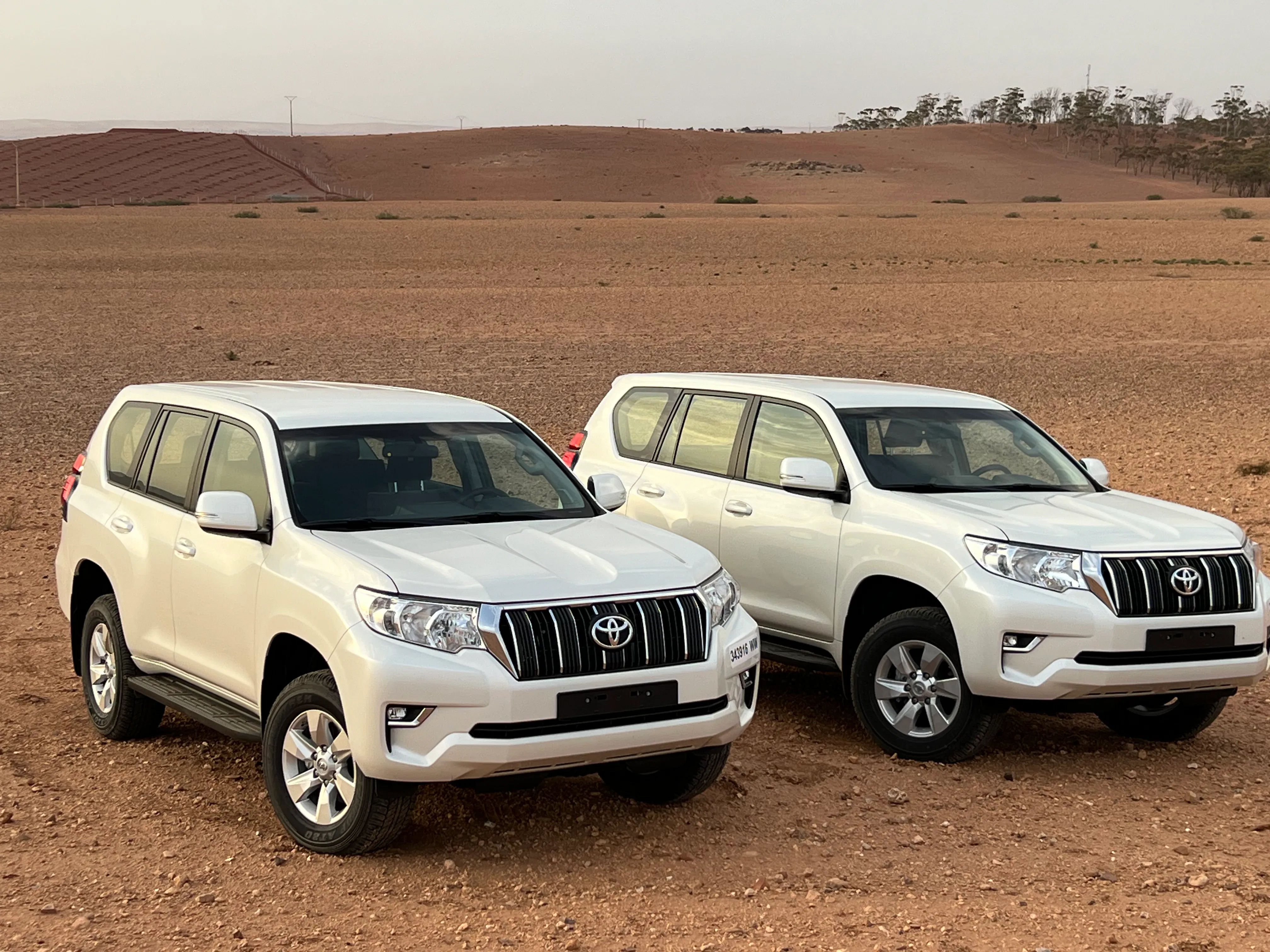
In Morocco, the word "4x4" covers two very different vehicle types, and most travelers don't realize the gap. True 4x4s like the Toyota Land Cruiser, Toyota Prado, Toyota Hilux, and Toyota Fortuner have low-range gearing, mechanical traction systems, and the chassis strength to take a beating on piste. Light 4x4s and crossovers — Kia Sportage, Dacia Duster, sometimes a VW T-Roc — give you four-wheel drive on paper but lack the gearing and clearance for serious off-road work.
That distinction matters more than the brochure suggests.
True 4x4 — Low Range, High Clearance, Real Off-Road Capability
The Land Cruiser, Prado, Hilux, Fortuner, and GWM Tank 300 in our fleet all share the same DNA: a separate low-range gearbox that gives you slow, high-torque control on sand, mud, and steep descents. They have the ground clearance to skip over rocks that would shred a crossover's undertray, and the cooling systems to handle 45°C in the open desert without overheating. This is what every aid agency, every official desert tour operator, and every Dakar Rally team uses for a reason. They're overbuilt for the task — which is exactly what you want in the Sahara.
Light 4x4 and Crossovers — Where They Hit Their Limit
A Dacia Duster 4x4 will surprise you on graded gravel — many travelers use them across southern Morocco for years. But on soft sand, on rocky pistes with deep ruts, on the long climb out of Foum Zguid in summer heat, a light crossover starts to struggle. The four-wheel-drive system in these vehicles is designed for slippery roads, not for crawling over a dune. If you're sticking to the paved approach and one short desert excursion with a guide, a crossover is fine. If you want to drive the desert, it's the wrong tool.
Which Sahara Routes Actually Need a 4x4?
Most Sahara routes don't need a 4x4 — the spine of southern Morocco is tarmac. You only need a real 4x4 for off-road sections: the piste from M'hamid to Foum Zguid, the Erg Chigaga loop, off-track driving around Erg Chebbi, and most "deep desert" camp access roads. Below is the honest breakdown.
Marrakech → Ouarzazate → Merzouga (Fully Paved)
This is the classic route — about 560 km, 9 hours of driving split over two days for comfort. The N9 crosses the High Atlas via the Tizi n'Tichka pass (2,260 m), then runs east through Ouarzazate, Tinghir, and Erfoud to Merzouga. Every meter is paved. A standard car handles it. The only "off-road" segment is the final 2–3 km from the village of Merzouga to most desert camps, and your camp will collect you in a 4x4 if needed.
Erg Chebbi Dunes Loop (Sand — 4x4 Only)
If you want to drive around the Erg Chebbi dune sea — Khamlia, Hassi Labied, Tissardmine oasis, the old Dakar Rally tracks — that's all soft sand and rocky black-desert tracks. A real 4x4 is mandatory. Most travelers do this with a local guide in a second vehicle, which is both safer and far more interesting than navigating solo.
Erg Chigaga / M'hamid → Foum Zguid (Serious 4x4 + Experience)
This is the wildest legal piste in southern Morocco — roughly 200 km of remote desert tracks between M'hamid and Foum Zguid, including the approach to the Erg Chigaga dunes. It needs a properly built 4x4 (Land Cruiser, Hilux, Prado), low-range gearing, ideally a second vehicle for safety, and real off-road experience. Don't attempt it solo in a crossover. People get stuck out there every year.
Agafay "Desert" Near Marrakech (Any Car)
Worth a quick mention because it confuses people: the Agafay is a rocky, scrub landscape about 40 minutes from Marrakech, often marketed as a "desert" experience. It's reachable by any car. It's not the Sahara — but if you're short on time, it's a real option.
Which 4x4 to Choose from Our Fleet
The right vehicle depends on group size, route, and budget. Here's how we'd match them honestly:
Couples doing the classic paved Sahara loop: Kia Sportage or VW T-Roc — comfortable, automatic, fuel-efficient. Not for sand, but perfect for the asphalt route.
Couples or small groups wanting off-road capability: GWM Tank 300 — newer entrant, real 4x4 capability, automatic, comfortable.
Families (5–7 people) on a long road trip: Toyota Prado or Toyota Fortuner — 7 seats, room for luggage, true 4x4 underneath.
Photographers, pisteurs, deep-desert travelers: Toyota Land Cruiser — the gold standard, built for the conditions, what every serious Sahara operator uses.
Pickup-truck lovers, gear-heavy trips: Toyota Hilux Double Cabin — load space, manual gearbox, proven workhorse.
You can see the full lineup with current pricing and availability on our fleet page. If you're not sure which one fits your route, tell us your itinerary and we'll match the vehicle.
The One Thing Most Rental Companies Won't Tell You
Most car rental companies in Morocco — including the big international chains operating at Marrakech and Casablanca airports — explicitly forbid off-road driving in their contracts. Take their car onto a piste, damage it, and your insurance is void. You eat the full bill.
This is the single most important thing to confirm in writing before you book a 4x4 for the Sahara. Ask the rental company: "Am I allowed to drive on unpaved roads and pistes? Is my insurance valid off-road?" If the answer is anything other than a clear yes, walk away. A 4x4 that you can't legally take off-road is just an expensive way to drive paved roads.
We confirm off-road permissions case-by-case based on your route — talk to us before booking if your itinerary includes piste sections.
Frequently Asked Questions About Driving in the Moroccan Sahara
Can I drive into the Sahara dunes with a rental car?
Only with a true 4x4 (Land Cruiser, Prado, Hilux, Fortuner) and only if your rental contract explicitly allows off-road driving. Soft sand will trap a regular car within meters, and most rental insurance is void off-paved roads. For the dunes themselves, most travelers use a local guide rather than self-driving — it's safer and the experience is better.
How long does it take to drive from Marrakech to the Sahara?
Marrakech to Merzouga is about 560 km and takes roughly 9 hours of pure driving. Almost everyone splits it over two days, with an overnight in Ait Benhaddou, Ouarzazate, or Dades Gorge. Marrakech to Zagora (gateway to Erg Chigaga) is 360 km and takes about 7 hours. The drive itself is part of the experience — don't rush it.
Is the road to Merzouga paved all the way?
Yes. The full route from Marrakech to Merzouga via Ouarzazate, Tinghir, and Erfoud (the N9 and N10) is paved tarmac, maintained to national-road standard. The only unpaved section is the final 2–3 km from Merzouga village to certain desert camps, and most camps collect guests by 4x4 from a pickup point.
Do I need a local guide to drive off-road in Morocco?
Legally, no — there's no permit requirement for self-driving on most pistes. Practically, yes for first-timers. Desert navigation is harder than it looks, GPS coverage gets patchy, and recovery if you get stuck is expensive and slow. For your first off-road Sahara trip, hiring a guide who follows in a second 4x4 is the standard professional setup.
What's the best 4x4 for Sahara desert driving?
The Toyota Land Cruiser is the working standard — used by aid agencies, professional desert operators, and every serious Sahara guide for a reason. The Toyota Prado and Toyota Hilux are very close behind, slightly cheaper, equally capable on most routes. For lighter use on graded gravel, a Dacia Duster 4x4 can work. For sand, dunes, or real piste, stay with the Toyotas.
The Bottom Line
Do you need a 4x4 to visit the Moroccan Sahara? Only if you plan to leave the paved roads. The classic Marrakech-to-Merzouga route works in any car, and renting a Land Cruiser just to drive it on tarmac is overspending. But the moment your plan includes dunes, pistes, or deep-desert camps, the right 4x4 stops being a luxury and becomes the only sensible choice. Tell us your route and we'll match you with the vehicle that actually fits — no upselling, no rental-counter surprises. Get in touch.